Sandolab
An informational record of Taylor Sando's work on AI-agent control systems, Sitelayer, and research-driven system design.
Systems below are live, screenshot-honest, or marked private. Build records and operational evidence distinguish working software from design notes.
Work Areas
Durable areas of the lab. These descriptions explain what each area is for.
Control infrastructure
Mesh is the authority kernel for task routing, runner state, file activity, research deposits, beliefs, telemetry, and operator surfaces.
The work is about defensible autonomy: leases, assignments, review gates, evidence, and a real audit trail for agent work.
Sitelayer
Sitelayer is the construction-ops product loop: blueprint takeoff, estimating, crew scheduling, rentals, inventory, QBO sync, and field feedback.
It is also where capture_session_id, support packets, context work, product trace, and deterministic workflows are being forced into a real product shape.
Evidence Flywheel
Browser-backed research, ontology notes, product traces, and agent outputs feed a loop of deposits, synthesis, follow-up questions, and implementation work.
The goal is not a demo graph. It is a system that remembers why work exists and which evidence should change the next task.
Selected Proof
Proof Layer
This site connects the public record to live systems and research. It is the detailed surface for inspecting how the work is built, bounded, and verified.
Operational control plane
Mesh, Orchestrator, OCC, and Console cover file activity, routing, policy, and operator-facing workflows.
Sitelayer proving ground
Sitelayer pushes the architecture through real construction-ops workflows, capture sessions, support packets, and product-trace handoffs.
Ontology and evidence
Digital ontology, payment ontology, and belief maintenance keep vocabulary, delegation, and evidence coherent.
Applied product threads
Sitelayer, Learn, tracking and overlay systems, Hockeypedia, and simulations act as live proving grounds.
Routing and auditability
Worktree isolation, task routing, review hooks, operator visibility, and the surfaces needed to keep agent work defensible.
Research automation
Seed, collect, synthesize, and follow up on research topics without losing the thread between source material and decisions.
Semantic design
Ontology work for control planes, payments, and broader digital systems when the vocabulary itself is part of the architecture problem.
Interface proving grounds
Game systems, overlay tools, analytics, and the Learn workbench give the architecture pressure from real interfaces instead of staying abstract.
taylorsando.com carries the concise professional profile; Sandolab carries the inspectable proof layer.
Product Threads
Public systems and experiments that show the range of the lab. They are evidence and working software, not a sales inventory.
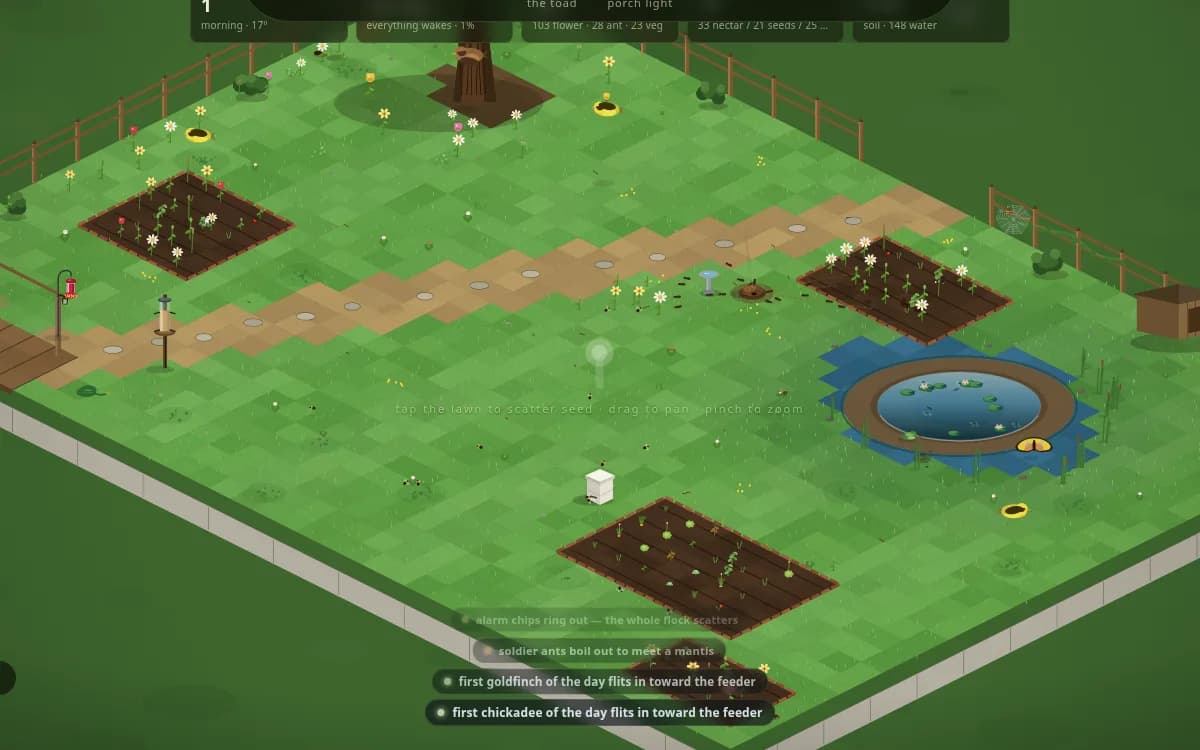
The Yard
yard.sandolab.xyz — one backyard, one food web
One unified isometric backyard where every sim shares the same clock, weather, and economy: an ant colony, a bee hive, a bird feeder, hummingbirds, butterflies, squirrels, a pond, and the night shift all trade nectar, seeds, insects, and soil through a single ledger. Lean into colony, hive, or feeder perspectives — some open live cutaway views — and the yard keeps living while you're away.
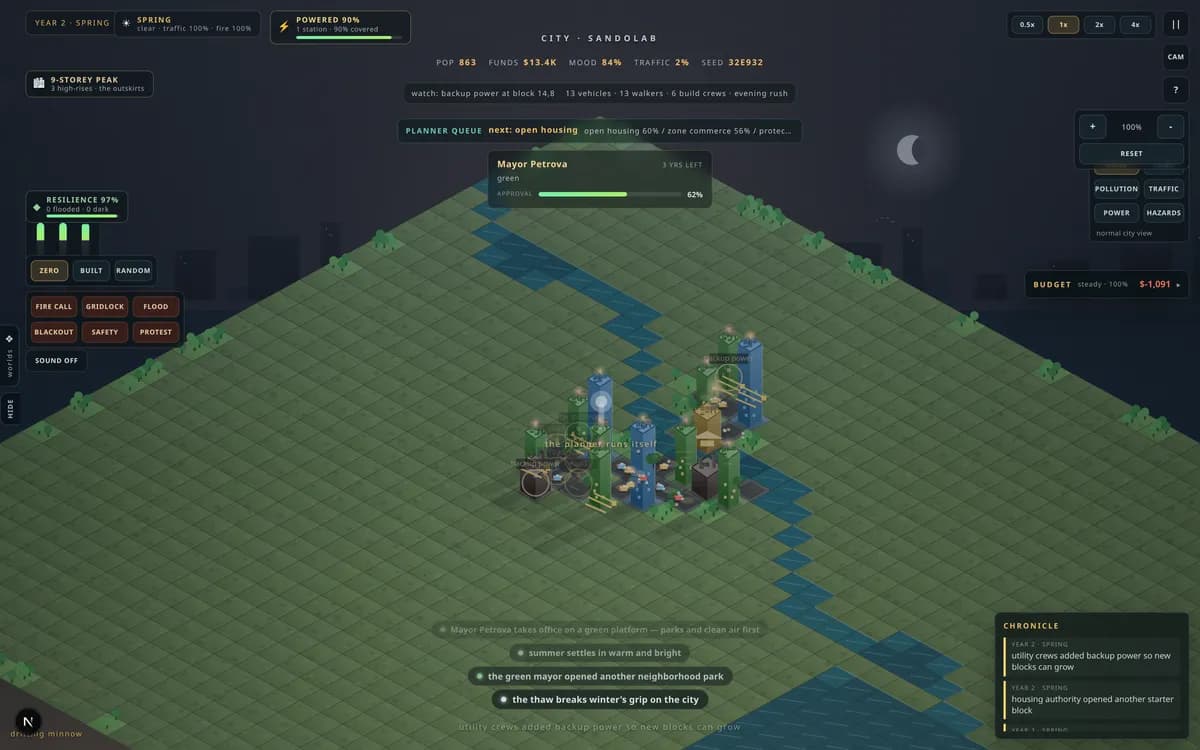
Autonomous City
city.sandolab.xyz — watch-only city-builder ecology
A city-builder-inspired simulation where city hall, demand, roads, services, traffic, taxes, land value, pollution, fires, festivals, and construction pressure all run without player controls. You only watch the planner's choices and the consequences compound.
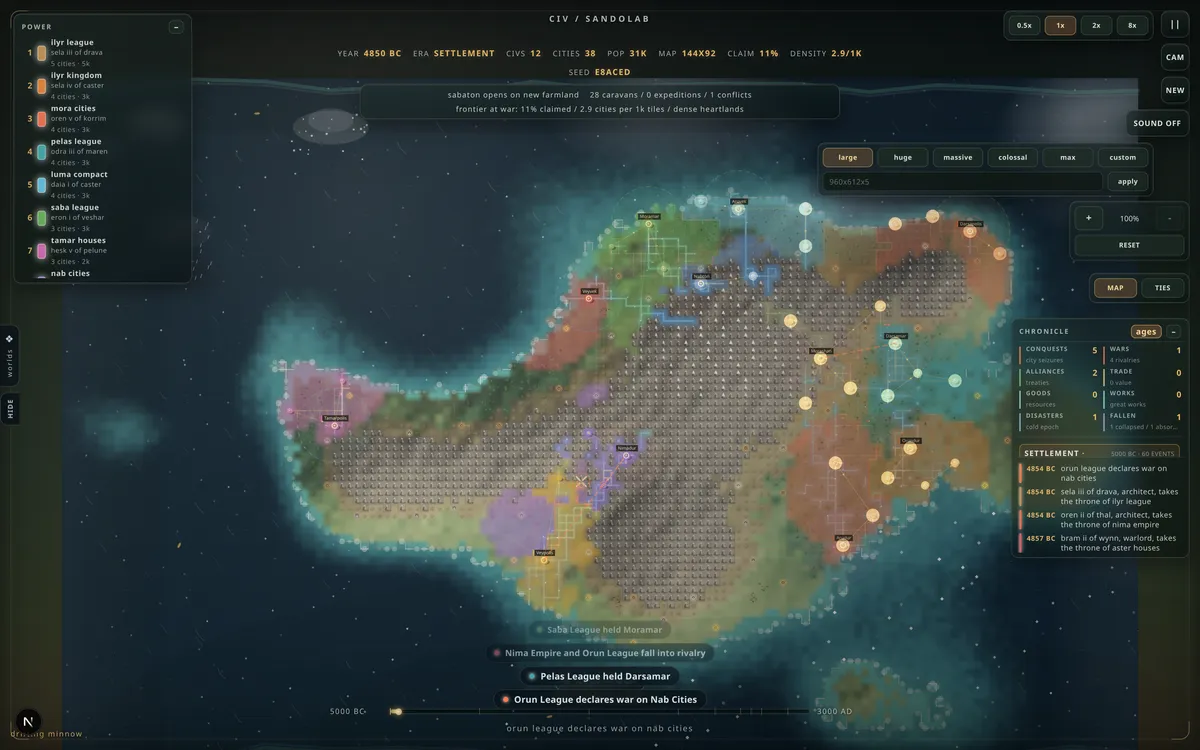
Civilization Map
civ.sandolab.xyz — 8,000 years of watch-only world history
A generated 2D world map where a random number of civilizations begin in 5000 BC and keep expanding, splitting, trading, fighting, migrating, and urbanizing until 3000 AD. You can zoom, pan, change speed, or roll a new seeded world, but the map writes its own history.
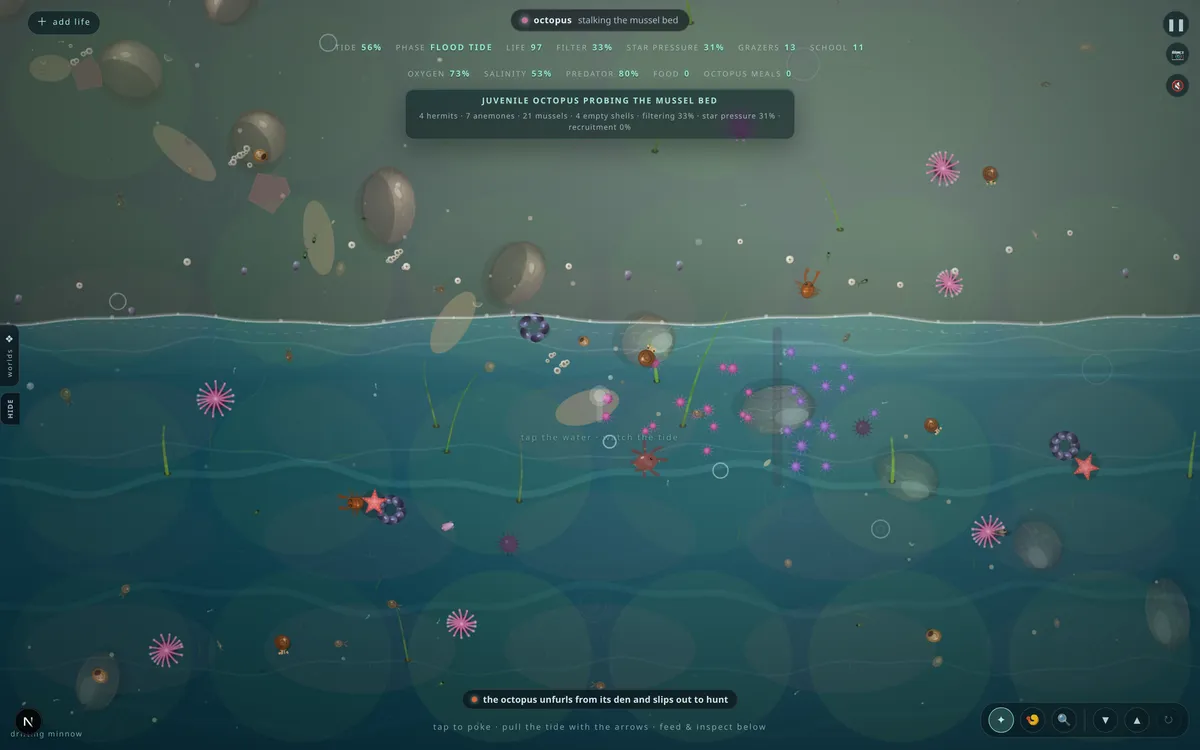
Tidepool
tidepool.sandolab.xyz — top-down rocky pool with a tide cycle
A top-down rocky tidepool with anemones, hermit crabs, sea stars, mussel beds, and a 4-minute tide cycle. At low tide anemones close and a gull occasionally swoops in; at high tide everything submerges and ripples scatter the surface.
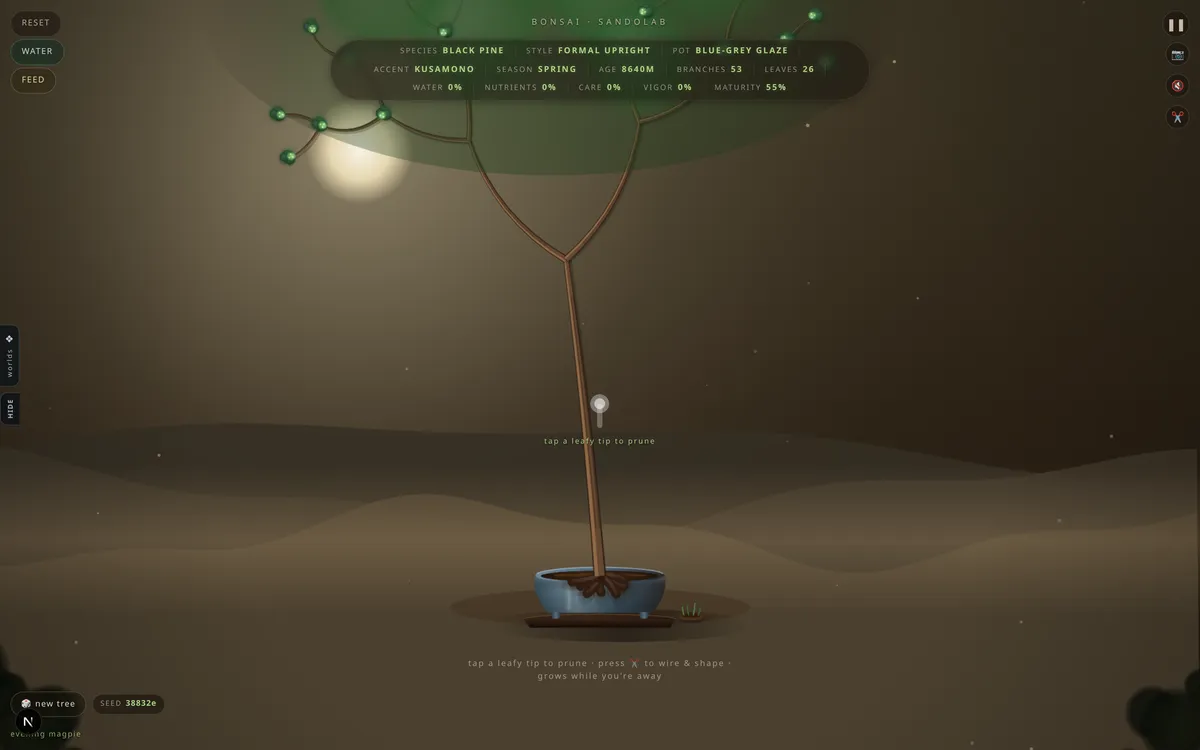
Bonsai
bonsai.sandolab.xyz — one tree, real wall-clock growth
A single juniper growing in real wall-clock time. Branches mature, leaves bud, new sprouts emerge. Click any leafy tip to prune that branch and everything downstream. The tree's progress is saved to localStorage so it keeps growing between visits — leave it for a day and come back to find new growth.
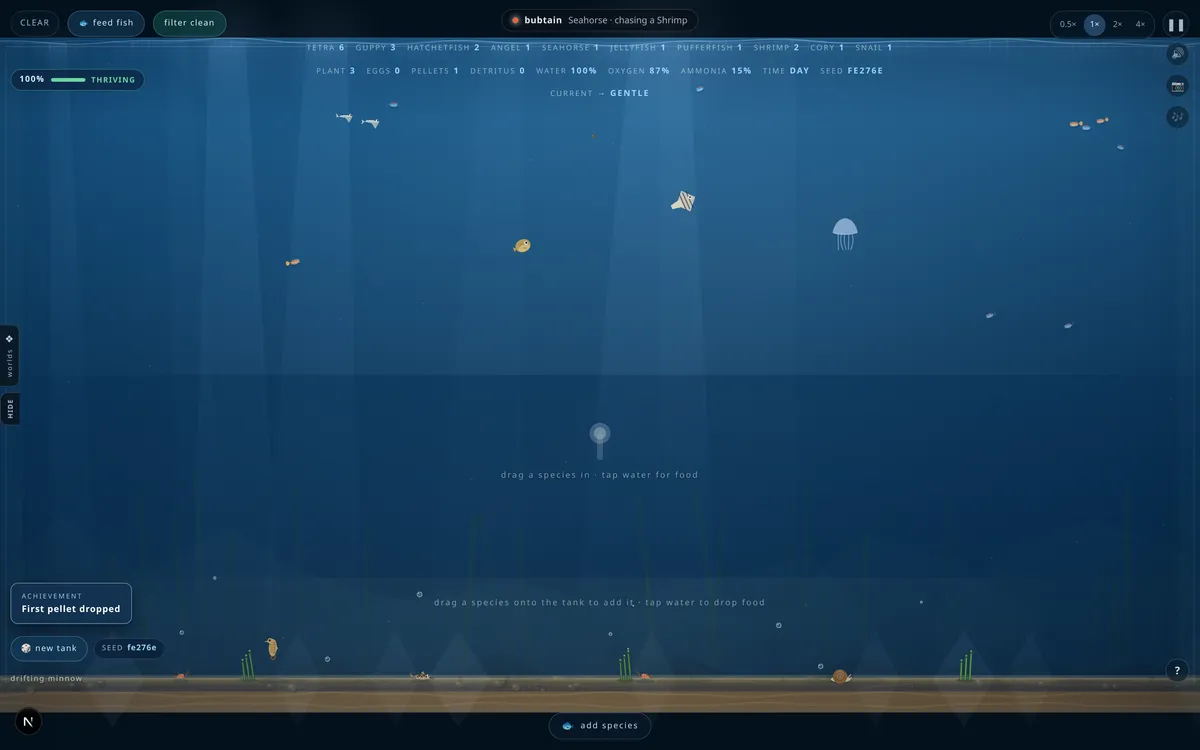
Aquarium
aquarium.sandolab.xyz — living ecosystem with a full food chain
A side-on aquarium tank with tetras, guppies, angelfish, gouramis, sharks, shrimp, snails, crabs, anemones, and plants. Full lifecycle: eggs hatch, juveniles grow, adults reproduce when well-fed, prey flee predators, dead fish sink and feed the scavengers. Drop pellets, place any species into the tank, and watch the food chain settle.
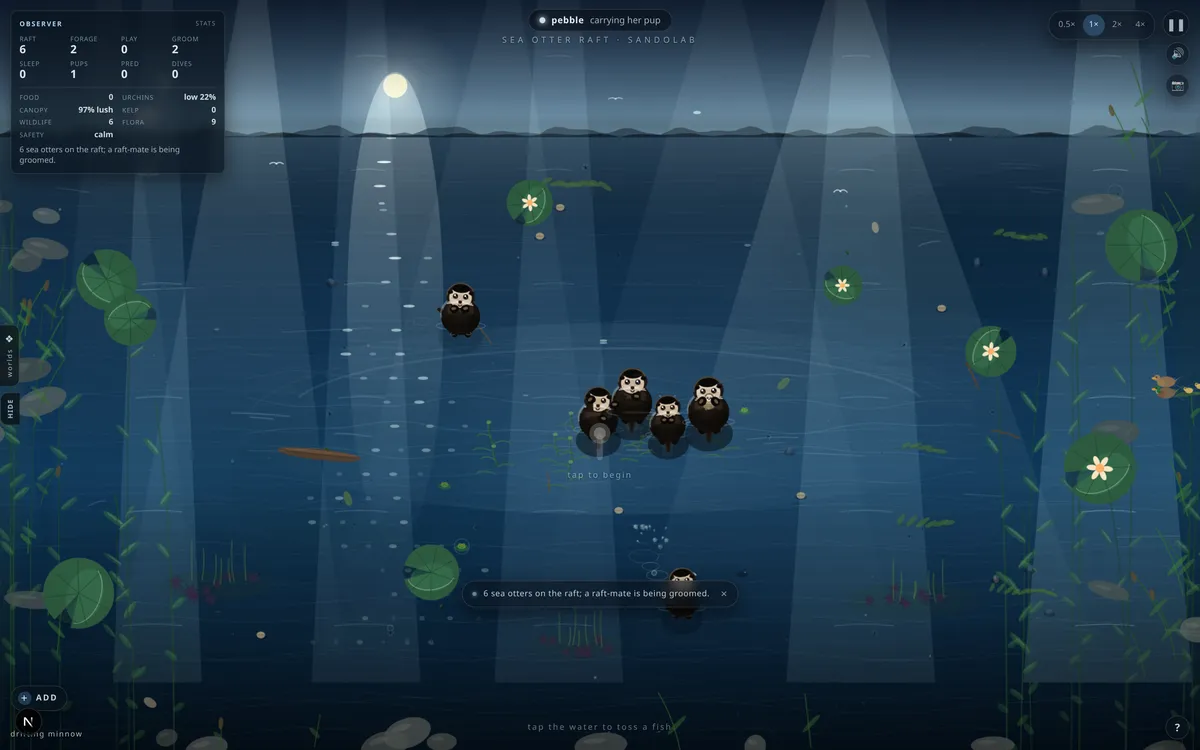
Sea Otter Raft
otter.sandolab.xyz — sea otters foraging, playing, sleeping
A six-otter raft simulation. Otters dive for clams, urchins, fish, and the occasional rock to play with; eat what they catch, groom themselves with both paws, sleep with paws over their eyes, play in pairs, and scatter when an eagle's shadow passes overhead.
Micro
micro.sandolab.xyz — a drop of pond water under the microscope
A microbial food web in a single drop of water: algae, diatoms, chemotrophs, bacteria, grazers, amoebae, predators, parasites, and viruses, each carrying a mutable genome so lineages evolve under the pressures they create for each other. Pan, zoom, inspect a cell's genome, and tip the balance with the tools.
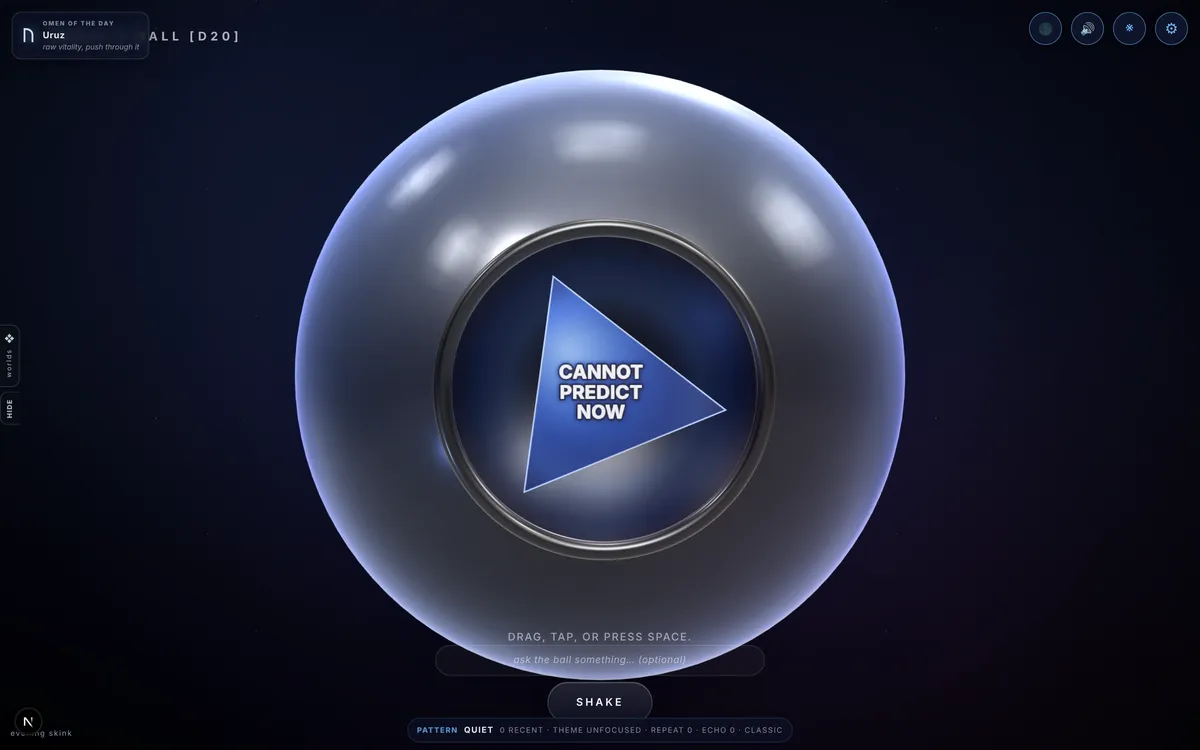
Magic 8-Ball
8ball.sandolab.xyz — physics + voice packs + horoscopes
A 3D Magic 8-Ball with multiple die shapes, voice packs, a council-of-three mode, a tarot spread, share-able state, and a CRT/Konami easter egg. Built to test how far a single-page WebGL toy can stretch.
Octopus Impossible Box
impossible-box.sandolab.xyz — useless-box mechanism with attitude
A tabletop useless-box toy: flip the lever or pry the lid, and the octopus inside opens the box just long enough to shut the switch off again. The timing varies between snap strikes, fakeouts, ink clouds, and lid tantrums.
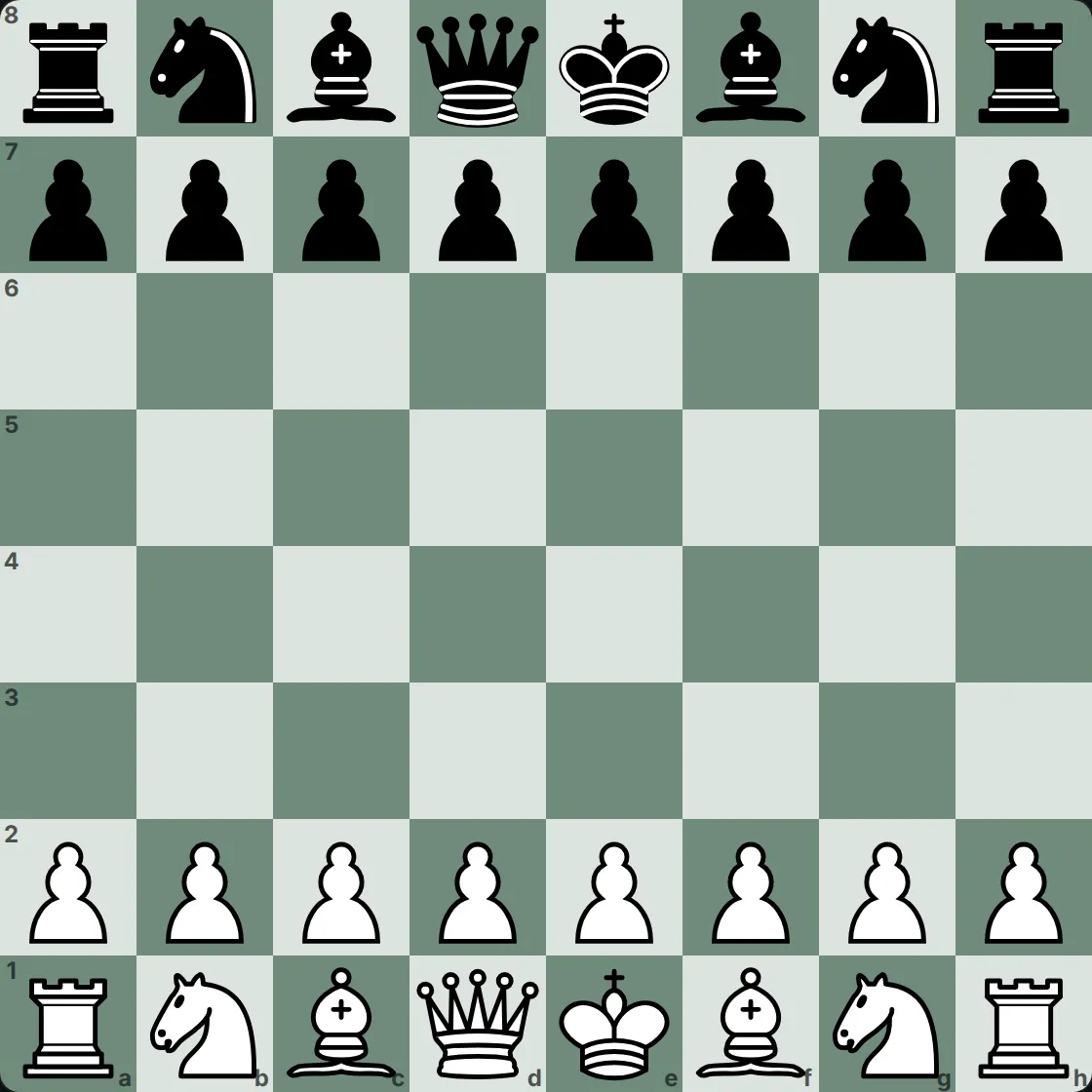
Chess Trainer
chess.sandolab.xyz — Stockfish play, puzzles, LLM coaching
A self-hosted chess training app: play graded games against Stockfish, drill adaptive Lichess puzzles, get LLM-written explanations of blunders and critical positions, and run spaced-repetition endgame drills — all behind a single-user Tailscale endpoint.
Digital Ontology
Layered thesis, belief maintenance, and stack-model research
A living ontology research corpus mapping delegation, authority, retrieval, trust, and control surfaces across the digital stack, with Mesh-backed belief maintenance around the long-form thesis.
Learn
learn.sandolab.xyz - standalone Mesh-backed study desk
A personal learning workbench extracted from the control-plane console: Today aggregator, library/PDF reader, spaced recall, glossary, ontology atlas, bridge signals, proof exploration, sessions, and diagnostics.
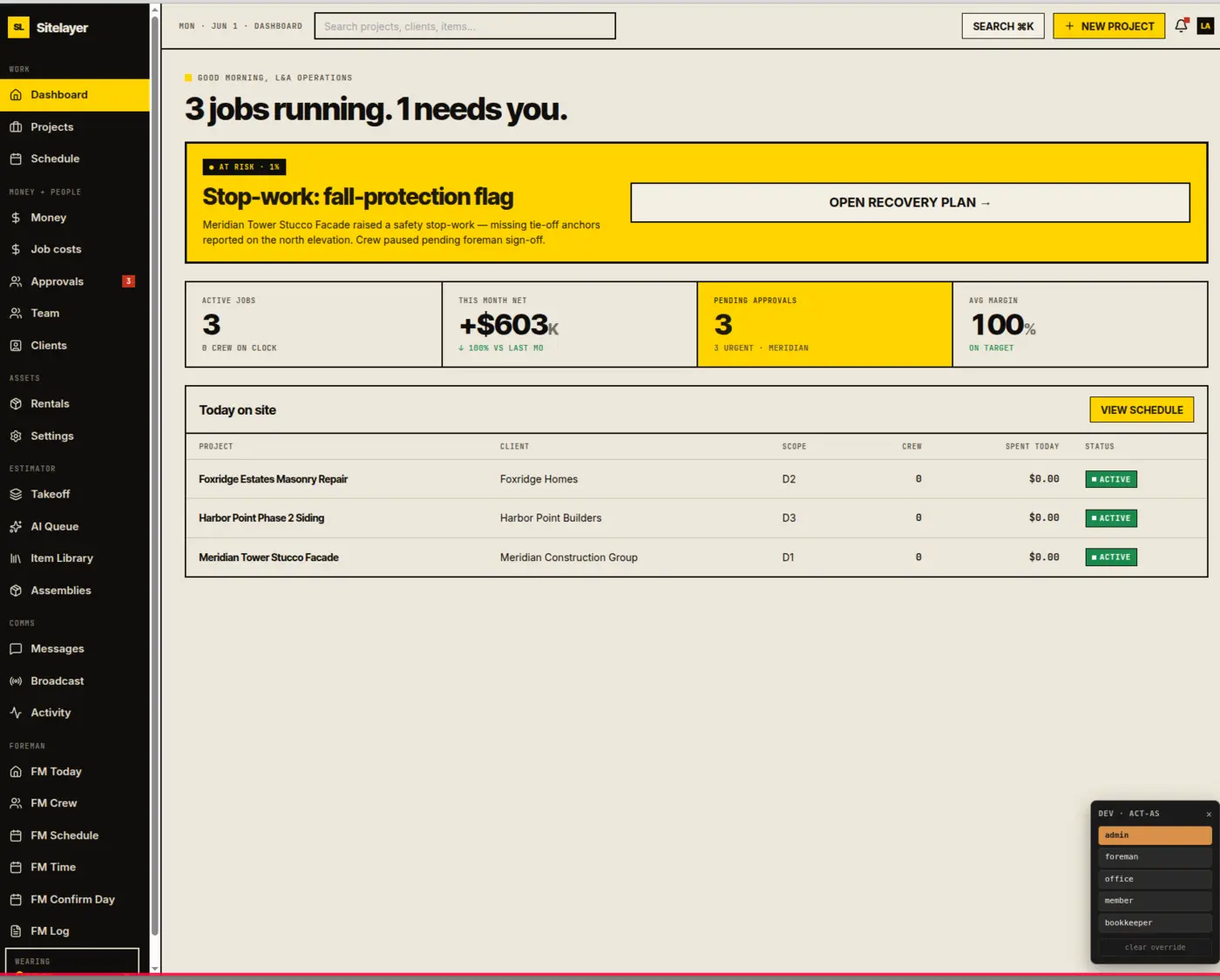
Sitelayer
Construction operations platform and capture loop
A construction-ops product for exterior cladding contractors, deployed and in pre-pilot: blueprint takeoff, estimates, crew scheduling, rentals, inventory, QBO sync, and feedback capture tied back to reviewable work.
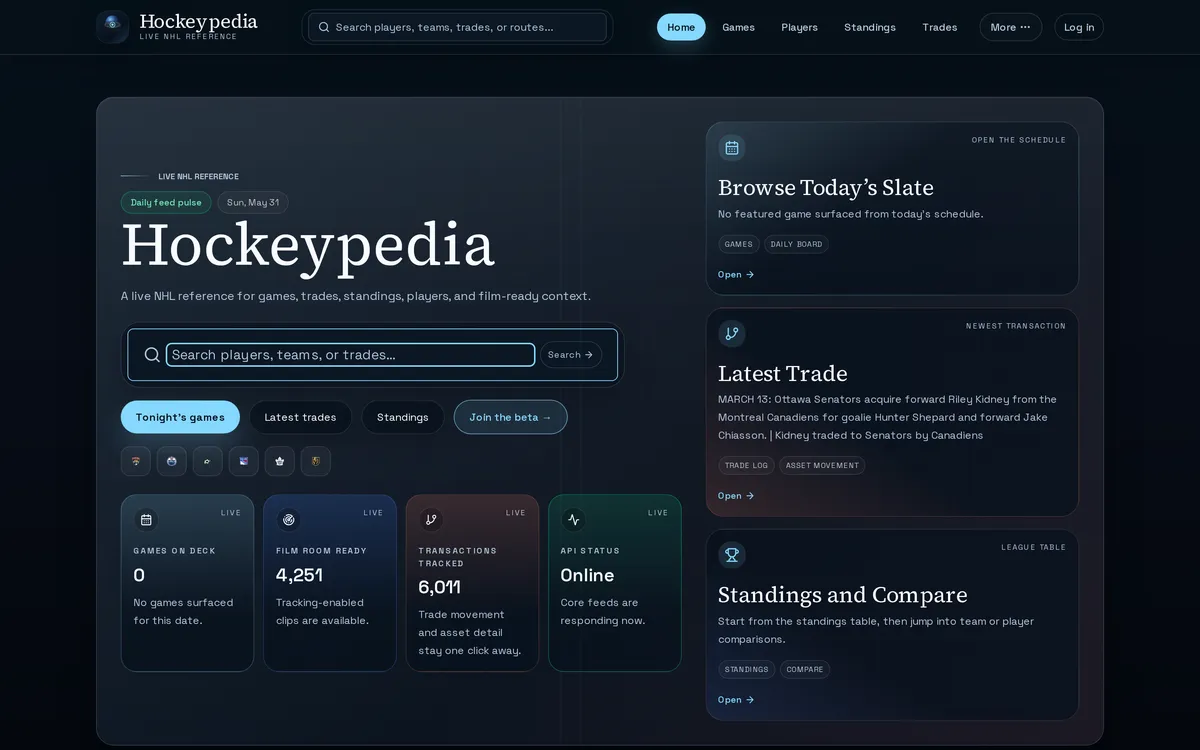
Hockeypedia
Trade lineage and NHL data work
Hockey data project focused on trade lineage, player/game ingestion, and public analytics surfaces.
Concern Protocol
Across these projects I'm extracting one pattern: product usage becomes structured evidence, becomes a reviewable concern, becomes an optional dispatch, becomes an auditable callback. The full loop is built and wired in Sitelayer's pre-pilot deployment; the reusable kit is being pulled out in the open.
Capture
Structured evidence from product usage — not a screenshot in a Slack thread.
Concern
A reviewable work item with the evidence, context, and identity attached.
Dispatch
Optional handoff to a human, an issue tracker, or an agent runner — under policy.
Callback
An auditable “what actually happened to this report?” resolution timeline.
Kit
The same loop, packaged for your product, with your own accounts and store.
Agent dispatch is pluggable. Sitelayer's dispatch adapter points at my private agent fleet — but the contract is swappable, so it can just as well point at your own runner, GitHub, Linear, or a human review queue. The private backend is the reference implementation, never a requirement.
The same evidence-to-callback loop is becoming the public thesis for local work: label the story, money, obligation, governance, and proof before inventing another platform.
Read the thought on taylorsando.com →The Research Flywheel
One public proof thread is the research workflow: notes, deposits, and open questions turning into a repeatable loop of collection, synthesis, and follow-up.
Multi-Model Triangulation
Topics can be researched by Claude, Gemini, and Codex in parallel, with synthesis capturing agreement and disagreement.
Readiness Checks
The workflow uses deposit counts, source variety, and review steps before a topic is treated as synthesis-ready.
Recursive Depth
Each synthesis surfaces new follow-up questions that can spawn the next topic. The system gets more useful as the loop continues.
Goal-Directed Literature Recognition
Current research tooling includes literature-scanning work tied to active topics so external sources stay connected to the control-plane agenda.
Research Threads
These are the research threads feeding the control-plane work, product experiments, and system-design decisions in public.
Control-Plane Ontology Curation
Knowledge SystemsOngoing work to keep the lab's ontology, notes, task history, and evidence layer coherent as new work lands.
Treats knowledge curation as a live control-plane concern rather than static documentation.
Digital Ontology
Ontology ResearchA living thesis on delegation, authority, identity, retrieval, trust, and control surfaces across the digital stack, with Mesh-backed belief updates around the long-form corpus.
Treats digital infrastructure as an ontology and governance problem rather than just an app or protocol inventory.
Payment Ontology Research
Fintech SystemsExploring the vocabulary, flows, and failure modes around payment systems so the lab can reason about money movement with less ambiguity.
Focuses on semantics and operational edges, not just integration plumbing.
Sitelayer Capture Loop
Product SystemsActive work joining capture_session_id, support packets, context work, product trace, and deterministic workflows in Sitelayer.
Uses a real construction-ops product as the proving ground for evidence-to-task loops instead of a synthetic demo.
Local Trust Layer
Civic SystemsWinnipeg is the source-grounded backstage map for local roles, levers, needs, claims, commitments, and boundaries; Sandolab keeps the public proof layer separate from the private coordination graph.
Tests operator benefit and community benefit through small proof-carrying operations, not a broad civic platform.
Tracking & Overlay Systems
Attention SystemsExperiments in monitor focus, room/world models, overlay surfaces, and desktop attention routing across sando-tracker, learning-overlay, and personal-usability.
Treats attention and overlays as connected system surfaces rather than as a standalone headset product.
Learn Workbench
Learning SystemsThe standalone Learn app turns Mesh learning APIs into a daily study desk, reading library, recall queue, glossary, ontology atlas, proof workflow, and diagnostics surface.
Connects reading, recall, proofs, sessions, and belief capture back to the same control-plane substrate.
About
Sandolab is the applied research lab of Taylor Sando. Public work here records the proof layer behind current systems: agent infrastructure, Sitelayer, research notes, and selected software experiments.
Relevant background includes University of Manitoba research in psychology and computer science, software work at SkipTheDishes, Datomar Labs, and ReLease/Cios, and current private control-plane development.
Based in Winnipeg, MB.